vrijdag 3 december 2010

EuroSTAR 2010 diaries - prologue

Sunday afternoon, there's snow in the air and I'm finally leaving for Copenhagen. Seems like only yesterday that I was in Galway (Ireland) with John Fodeh, Peter Morgan and Rikard Edgren (and off course the Qualtech People), but time has really flown by this year.

A lot has been going on also; with the VideoSTAR, BlogSTAR, TestLab apprentices, TeamSTAR et all. I'm quite exited for the week to come... "how will the delegates respond on the program?", "how will I do myself during this week?" are a couple of thoughts I have.

The travel to Copenhagen didn't have any noticeable delays, and I was lucky I guess, since others were not that fortunate and had quite a travel to the conference. Snow and wind combined even got the airport closed on monday morning. Later I heard it has been not this cold in Copenhagen since 130 years. The hotel (Crowne Plaza Copenhagen Towers) was excellent! Very modern and easy reachable by public transport (there was a minivan to pick you up from the airport though). I had a very luxurious room, which apparently was a 'standard room'.

And I was looking forward of using the lounge chair after a conference day with a mug of (complementary) hot chocolate and have a look at the magnificent view over the city (I was on the 14th floor -cityside).

When I hung out my jackets and everything I went downstairs to the bar and met up with the Qualtech 'bunch' that were already had been very busy at the BellaCentre setting up all the stuff for the conference. They really have a lot to do before it actually starts for the delegates (something you don't actually get to see when you're 'just' visiting but in my role as program committee member has made me very aware off GREAT JOB YOU GUYS!). I didn't make it very late, because I airtravel makes me a bit tired and I really wanted to be fresh for the tutorials and the conference (and the drinks are actually VERY expensive in Copenhagen, where I paid 9 EUR for a glass of white wine in the hotelbar, so it's not that attractive to go 'slamming' very fanaticly)

- Did you know that Qualtech actually gets started on saturday before the conference morning early with building up the whole conference surroundings etc. ?
- Did you know that Qualtech had to ship 70 boxes of stuff from Galway to Copenhagen? (containing among others: the conference bags, the wristbands, the infoposters, the booklets, the speaker/ trackchair gifts and many other things?)
- Did you know that they were present even before 7 in the morning for the early birds? and that the Testlab opened up on wednesday the same time?

vrijdag 26 november 2010

Frustrated by Dutch Tax Authorities

As you may or may not know. I have a small company which sells Casualty Simulation Victim supplies, it's a small business with small margins due to the fact that most Casualty Sims in NL work on non-profit basis (or even charity).

My first salestax declaration I had to do by hand and was well within the time limit. The second however I had to do by a 'secured internet site'. Now you have to know, that in NL we know something that is called DigID, which is a governmental electronic ID to do all kinds of digital transactions and information on governmental sites. So I totally assumed that I had to use my DigID to do this tax declaration.

The week before the deadline (23rd of October) - well within the limits- I sat behind my computer to do this digital declaration, only to find out that I apparently needed a specific other loginID and password. It was Saturday, late in the afternoon, so I had to wait until Monday to call the Tax Authorities to request this ID and login.

I got a lady on the telephone which told me that she would send a new ID and WW which could take up to 8 (!!!) workingdays to arrive. So I told her I would be late with my declaration if it was to arrive later than the 31st of October (deadline).
She told me that when I was within 7 days of the 31 st (and I assume workingdays here too) that would make 9th of November I was still 'good'. I was worried since I'm away a lot and told her this; she told me that she would make a note and that I would be fine (perhaps she meant 'fined').

I got the ID on the 2nd of November and the password on the 4th of November. I was away then, so when I arrived at home I inmediately did my declaration (on the 11th).
Mind you: my declaration was 'negative' so the authorities would have to pay me instead of me paying them.

So, yesterday I got a 'bleu envelope' with a notice of omission and a fine for 56 EUR. and I was appalled.

Today I called the Tax Authorities and told them the story and that I followed procedures within my limits.
The guy who was on the phone simply said. You were too late and the penalty for that is 56 EUR.
When I told him of the letter that had arrive during absence and that I told the lady on the 25th and she would make a not; he said; It's not in the system, only that your declaration is too late. It's your responsibility to be at home when this letter arrives (what???) and you should have taken actions (what???). You should have known earlier that you had to have these other ID and password or you shouldn't have lost them (I didn't loose them; it was my first request!) and after that he concluded that there is no such thing as a extention of enddate for these declarations (why did the lady than say there would be a note???)

So I told him I didn't find it proper behaviour from the Tax Authorities in this case: I was on time (with both the request of the ID/Password AND the mentioning that I wouldn't be able to do the declaration because of not being on location when it would come in), than saying there would be a note and than nevertheless send me a fine... He said (and this made me really furious!) : that's your opinion but nevertheless you have to pay up.

Do they teach those guys to give answers that infuriate people?
Why aren't there any exception business rules; surely I'm not the only one that encounters these problems? Is the Dutch economic situation THAT bad that the Tax Authorities are into 'easy money' obtained by these (I find unethical) practices?

At least it 'cleares' a bit of the frustrated feeling to blog about this. I'm only a small business/ one person and the Tax Authorities are a huge organisation who can do a lot more 'nasty stuff' to you if you don't obey, so I won't be able to do much more than warn people that if 'they' say that they will make a note when requesting a extension of sales tax and it'll be okay: there is no such thing and they will fine you no matter what the circumstances and there will be no warning either.

vrijdag 19 november 2010

Expo:QA 2010 - Warm welcome and conference in a bit cold Madrid, day two

So, it's Friday already, the day after the ExpoQA conference. Just did breakfast with Martin Pol and Niels Malotaux and had some nice discussions about 'testing in the Cloud' or to be precise: the nonsense of this concept without knowing the true and accurate definition of 'cloud' and some other definitions. I'm already checked out and waiting for my husband to arrive, which I do currently in the 'PianoBar' of the hotel (much more comfy than the airport I thought). Time to write part two of my experiences at ExpoQA...


I woke up early on Thursday. Nervous and really still exhausted 'cause of the short night. Had a quick breakfast and ran off to the bus that was already waiting in front of the hotel to bring us to the conference venue.
I had to start this day with my 'Ethics debate', my co-host was Ewout van Driel (Sogeti, Spain) and I was introduced by Graham Thomas. It was tough and had to do some minor adjustments. A debate is especially difficult it seems in Spanish Culture, during the early morning and the simultanous translation is a bit hindering I find and the acoustics in the room were not that great either. But it went OK and the most important - and what gave me a really good feeling- was that people (although they did not perhaps have the courage to speak out in the crowd) were really discussing and debating amongst small groups. Dorothy Graham was my Mystery Guest and I think she did an excellent view on Ethics and Software Testing (thank you Dot!). She also mentioned a book you all should read, called: "Mistakes are made, but not by me". I didn't get 'high-in-the-sky' scores, but feedback was excellent and I think it's very positive sign that most people bothered to SMS (which costs money) to vote (I had 32 votes last time I checked and that was most votes of all tracks): THANK YOU ALL!!
During the day there were also numerous smaller discussion on the subject, so this made me feel very proud too.

Next I had a very though choice. Iris Pinkster did her presentation on Lean Test Management and Martin Pol on How to successfully Oursource Testing. I chose the latter. Since I will see Iris on EuroSTAR also when she's doing a Tutorial on the same subject and I won't see Martin there.


Next was the famous coffeebreak. It's amazing how much and how good the extra food and sweets are here. There's so much choice and if I didn't restrain myself I would certainly have 'pigged out' on the varous delicious sweet pastries.

After the break I went to see Jan Fish, again after a though choice, because 'Celestina Bianco's, Agile Validation for Medical Device?' seemed very interesting too. Jan Fish (USA) had a presentation about going to CMMI level 1 to 5 for QA in less than four years. And I AM very interested how she accomplished this. Three things I like to mention here are:
- Enable your people to grow
- Documented unit tests are rare
- Sticky Minds article from 30th of December 2008 by Michelle Sleiger 'Questions you should ask'
I know this is a bit out of context, but also look at the slides and the description of here track and you'll get the picture. Jan Fish is a very nice lady, and I'm glad to have met her (during the conference dinner last night I joined her (and husband's ) table and had a very good evening. She also very natural and dynamic on stage and doesn't hesitate to come of stage to approach someone in the audience that has a question.


The next track I went to was 'Help, We have QA problem!' by Niels Malotaux. That wasn't a though choice since I already volunteered to track-chair this track. I thought it was a very clear, very sound and easy to understand presentation. And others thought so too, because this track was rewarded with the Delegates Best Track award. I would like to mention here that you should read 'Deming' and two quotes:
- Let's DO something about it
- It's our business to make people HAPPY.

Dynamic Niels during his presentation...

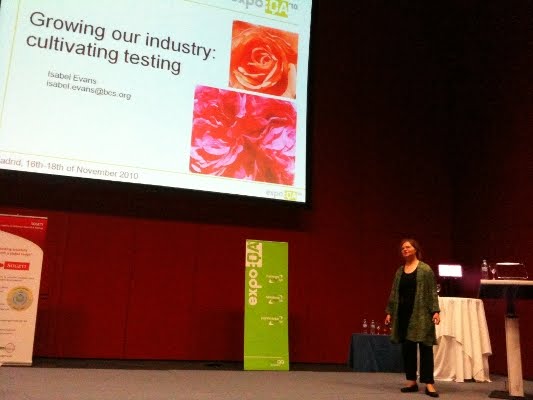
After a great lunch, with - YEAH!!!- TAPAS again (It's really excellent lunch here!) I went to Isabel Evans' Keynote about 'Growing our Industry: cultivating testing'. It was a typical Evans keynote, easy to listen too, great stuff and very passionate about both horticulture and the testing profession. It was no surprise here that Isabel's abstract was rewarded BEST by the technical committee.
And I was very proud that the Ethics Debate was mentioned a couple of times here in relation to the contents of her keynote.
Some other things I wrote down during the keynote:
- Isabel was inspired by the level of passion and level of control combined in the Flamenco show last night.
- We are here to make the next Generation of tester even better
- Professionals have a known level of competence
All I can say is: Go see this keynote if you have a chance!


I planned to go to 'Ignacio López Carrillo's "How can you demonstrate savings from software tests?". But I ran into Derk-Jan and some other people which I had a really good social talk with. So I decided to skip the last track. It also gave me a good oppurtunity to say goodbye to some people who had to leave somewhat early of right after the conference. Luckily Derk-Jan was pursuaded to stay during the closing of the conference because his abstract got a special recognition from the technical reviewing committee being the most mentioned one! (Isabel Evans got 'best abstract').

At the closing of the conference I saw a familiar image... It was the Expo:QA cartoon from Andy Glover, a.k.a. CartoonTester (recommended blog!!!)

The prizes were handed over, the delegates, speakers and chairs were thanked and than there was a farewell coffee (again: great pastries!)

And that concluded the conference Expo:QA 2010.
I really hope to be able to attend again in the future, since I found this a very intimate and relaxed, well organized conference (about 300 delegates).

When we left for the bus to bring us to the hotel again. I approached Geoff Thompson on an idea Isabel had invoked during her keynote and I think you can expect more from this in the future! We already had a ball with the first ideas of this concept, which I'll keep a secret for now... (btw Geoff is partipating in 'Movember': this is a moustache growing sponsoring event regarding prostate cancer during the month november; please feel inspired to sponsor participants of this initiative!).

So... next I'll be blogging about will probably be my EuroSTAR 2010 adventure in Copenhagen. Hope you will tune in again then!

donderdag 18 november 2010

Expo:QA 2010 - Warm welcome and conference in a bit cold Madrid, day one

Finally I got a chance to blog on Expo:QA 2010. It's been a very hectic and very busy few days, but now I'm in my hotel room after the conference has closed and have some time on my hands to blog. There wasn't any WiFi at the conference centre (wel no FREE WiFi) so I was also a bit mellow on the tweeting and the blogging certainly had to wait. So, what I've been up to the last couple of days...starting with arrival and day 1.


Some pretty pics of the flight from my window

I arrived in Madrid at 14.50 at the airport and was in my hotel (arranged by the ExpoQA people) the Avn. América Meliã (wich is quite good!) at four o'clock.
room at hotel

I met Derk-Jan de Grood of Valori in the lobby and we had a social drink before attending the track chair meeting in one of the meeting rooms in the hotel. The meeting was to instruct all the trackchairs on the procedures and the Vota-y-Gana (vote and win) system that would be used by the delegates to rank the different tracks and keynotes.
After that there was a social drink with the speakers and chairs in another meeting room, which was quite nice and informal. The only missing group were the speakers from the UK who were delayed because of heavy fog (I heard they had to wait for 5 hours at the airport to finally depart). Me, Dorothy Graham, Martin Pol and Derk-Jan decided to have dinner at the restaurant only to find out that it wouldn't be open till 20.30, so we had a 'quick bite' at the hotel bar and decided to go to bed early because most of us were very tired or had to work on their presentation some more. When we left, we ran into the heavily delayed UK people finally arrived at the hotel as well.

On Wednesday was an early start. The ExpoQA people had arranged a shuttle bus (coach) to go to the conference centre, which left at 08.15 from the hotel, which was excellent service and very relaxing since I didn't have the stress of having to find a taxi and also could have some chats in the bus with other attendants.
The venue itself is gigantic! The ExpoQA conference itself was held at the North Entrance and was at a first floor level. I found the set up excellent. Four rooms, situated around the vendor booths and two counters where coffee was served during the breaks. Coffee was always sponsored by one of the companies and accompanied by some sweet snacks.

Batch and conferenceguide of Expo:QA 2010 - I was really there :-)

Raynald Korchia opened the conference with a warm welcome to all delegates and at 9.45 the first keynote was held. It was a guest called 'Arnold Aumason'and he told us about worldwide testing services market 2010-2014: Key Growth Opportunities and Sector Trends. I didn't really hear anything new or revelationous here and the voice of the speaker was very monotonous so I couldn't get really exicted about this keynote.


The second keynote was the one of Dorothy Graham: What Managers Think They Know about Test Automation but Don't. I would like to reference to the information on the ExpoQA site (www.expoqa.com) to look into the info. There wasn't any real new information here for me, although I caught some ideas here, but specifically for the less experienced testers this was an excellent track and Dorothy is a dyed-in-the-whool speaker.


After these two keynotes there was a coffee break, with yummie treats and - for me as 'Dutchy' - a bit weird coffee where normal milk is mixed with very strong black coffee if you want 'coffee with milk' (we know 'cream', but it's an unknown concept it seems here in Spain).

When I finished my coffee and had some chats I had to choose the next track. It was a choice of four each time and this time I chose: The Cassandra Syndrome: The Tester's Dilemma and What to do about it by Rick Hower. He had a very funny anecdote about an embarrassed cat which had sprang into closed pation doors and actually looked embarrassed when he was up on his feet again. It was a very entertaining presentation with some good info and some interesting points, one statement that particularly interested me was "how much truth is too much truth?".
Rick has a site which you can visit on: www.softwareQAtest.com.


My other choice would have been the track of Derk-Jan de Grood on selecting the most effective test design techniques which - afterwards- got some excellent feedback, but in this case I choose the 'foreign' one that I was less likely to have an oppurtunity to see again. I'd like to mention here that Derk-Jan also received a special mentioning for his excellent abstract that was mentioned the most by the technical committee in the closing of the conference.
The next I chose was the track of Geoff Thompson called 'Testing, so many problems but we have the solutions don't we?". It was about 'craft' v.s. 'profession' and the Dunning Kruger effect where IT suffers from apparently. Some nice expressions from this track were 'Illusory superiority and inferiority' and 'The Silver bullet is YOU'.


The lunch after these tracks was absolutely fabulous. It was the famous TAPAS from Spain and different small delicious foods were constantly distributed during the (1,5 hour) lunch break. Accompanied by softdrinks and wine!.

It made the keynote after the lunch a though one, heavily fighting off my after-lunch-dip. But the speaker 'Alan Brown' was very good and kept me awake effortlessly. It was about 'Best Practices for Delivering Quality Solutions in a Ditributed, Agile environment' and I would like to mention 'Rational Team Concert' here, that was the main player in this keynote.


After this keynote I went to Virgina Chalegre about Accessibility Testing Methodology for Visually Handicapped in Web Environments. And I was really intrigued by a tool that read out the text from the screen and the difficulties one with a visual handicap has to face on the www. It was a track in Spanish and it was actually the first time I encountered this 'synchronous translation' and found it brilliant. Oh; also, a website that is suitable for visualy handicapped isn't per definition ugly for non-visually handicapped people.


After the coffee break I had a conversation with my co-host (Ewout van Driel) and chair (Graham Thomas). And I was actually 22 minutes too late for the next track. I chose to go to track one (Peter Farell-Vinay with Release Readiness) but in stead rushed into track 2 by mistake. It was in Spanish and I didn't have the translation headphones with me, but also to embarrassed to leave the room again and actually I didn't have the heart to leave the room again. Luckily the slides where in English and I could understand some Spanish words, so I think I got the message of Graham Moran's Test Tool Evaluation and implementation.


At 18.00 there was a bus to the hotel again, arranged by the ExpoQA people. We were supposed to leave at 19.15 again to the Florida Park to have a Networking Dinner with Flamenco show. But traffic was SO heavy we actually arrived at the hotel at 18.55 and had to really hurry up to get dressed/ have some freshing up and run to the bus again. Well the bus left at 19.30 or so and we had an excellent drink before a good dinner and a great show with - as Isabel Evans stated today- great level of passion combined with great level of control. I wasn't allowed to take any pictures inside, so you have to go and look at this show when you're in Madrid yourself.

I arrived at the hotel at 00.30 and was too exhausted to blog the day and I had to get up at 7 today again so this is why there is such a delay in my experience blogging.
I will blog about today (day 2) later on, because now I will go to dinner (it's 20.40 now) after I have also put the photo's with this blog.

dinsdag 16 november 2010

Dutch Testing Day - Naturalis Leiden

Currently I'm on my way to Madrid for Expo:QA and since I'm waiting for boarding, I finally have the time to blog about the Dutch Testing Day at Naturalis, Leiden on the 4th of November. Organized by Collis this time.

I went there much later then I expected; some issues at clientside occured which had to be solved first so I drove to Leiden rather late. In my mind I had the 'Corpus' as the hosting venue so I drove there. There was little parking space so I parked about a km away, walked there only to find that the Testing Day was at Naturalis. So walked back again (fighting my way through fierce winds of an autumn storm) and drove to Naturalis. There was the same parking problem there, so I parked at LUMC (hospital) and walked to the main entrance of Naturalis, only to find that I had to walk all the way back to the PestHuis where the event was held. At the door was a note with mobile numbers to call when I was to attend the Dutch Testing Day; and when I finally got in I felt I had just participated in a puzzle tour or something similar.

But I had a good lunch. I was surprised not to see any booths here from the sponsors, instead they were at a seperate hall behind the atrium where the tracks were held. I found this a bit dissapointing; a lunch is - for me- a perfect time to catch up with some vendors and competitors/ colleagues; by this setup I kinda missed this oppurtunity.

I missed the first couple of tracks. So my first track to attend was the one of Experiences with Formal Engineering: Model-based Specification, Implementation and Testing of a Software Bus by Marten Sijtema. I had forgotten the academic approach of the Dutch Testing Day and had to get used to the material for some minutes. But the track had some good points and some familiar info I had in a Dutch Testing Day (at Eindhoven) before. Next was the track of Panel questions to Model Based Testing Speakers (Jan, Neda, Axel & Marten), followed by - and this was a surprise- the track from Rik Marselis about End-to-end testing in the public domain, this one was supposed to be held in the morning so I thought I missed it, but instead I got to see it still. The last of the mid-day session was a track called "A comparison of free tools for Domain Specific Test Languages" by Martin Gijsen. I like this last one about the different tools. And I really like the setup of 1 track at a time; this way I don't have to choose which one to attend, which makes it easy :-)

The drinks were luckily at the vendor/ booth space. So I could catch up with some people and the buzz.

After the break there were two more tracks; well a track and a keynote. "The business case for Application Virtualization in testing complex distributed application architectures" by Edwin van Asch, was the first. Followed by Computer Security by Bart Jacobs, which I like a lot actually! After that there was the closing up of the event and there was a closing drink in the booth space.

I didn't attend the drinks afterward, since I was so awfully busy and had some other obligations to attend that evening. But I suppose they were ok since the whole entourage was very good.

I had a good event and heard some good stuff during the day. I found the venue a bit weird and not that well setup, but that's my point of view (and maybe the titles from the presentations where too long :-)). I liked the one-track-at-a-time setup (allthough I heard some people they would have liked a choice). The food was good (hot pastry and some good sandwiches!)
I will certainly attend next years Dutch Testing Day if possible at University of Twente (Enschede?).

Look for content on the tracks at : www.testdag.nl

So, now I'm about to board the plain to Madrid (I hope, since I don't see the actual plain yet...:-& ) and hope to keep you updated on my Expo:QA2010 adventure on this blog!

vrijdag 29 oktober 2010

5 mins or 30 mins, that's the question...

The week before this one, I commuted to work by train and got inspired for this blog.
So what's the story?

The last couple of weeks our national public transport train company - apparently- had loads of trouble keeping to their timetable (and IMHO still do but that is another story). Every single day for the past weeks the train has been delayed for 5 minutes and that made me 'tweet' the following:

"I find it more annoying to have a 5 min delay every day than to have 30 mins delay once in a while. "

and after that :

"I guess my last tweet about train travel, could very well apply to software testing too??" and "What do you think: Less annoying to have a huge bug once in a while, than numerous ones almost constantly"


I got the following responses:

@santhoshst : "True - I related it to Performance Quality criteria :) #softwaretesting

@santhoshst : "Depends on the context :)

@jahoving : "but even more annoying to have no bugs at all ;-)

@eddybruin : " 1 huge bug is better manageable than 100's of inconvenient little bugs"


There are not many replies, but all replies have something that made me think about this statement more. I have put down some thoughts/ questions that I had and would love you to respond on that!

- No bugs at all can mean a couple of things (amongst others): 1. the utopious perfect programmer has arrived to program the utopious perfect analyst's and designer's work. 2. you have not tested the right part of the software, are not performing the right tests or have automated your tests and this only checks things leaving the really important bugs unfound.

- It's annoying to get bug reports constantly. It's better to report once in a set time than to come running over to the programmer/ manager (etc.) with every single bug found. Also the 'huge bug-rule' can apply here; a huge bug can be reported immediately (it probably has to be fixed with high priority too) but all those little ones? Report it once a couple of days; else it will interrupt the programmers work (and attention) unnecessarily. It will also cloud a managers view; when you come to him constantly with every bug: the really important ones will not seem as important as they really are (famous fable of 'Peter and the Wolfe')

- When looking at performance issues. When you have - for example- a 7 seconds delay at every request this can be seen as not a big issue (in the margin) but a 1 minute delay is seen as problem. As a user 7 seconds can seem like a eternity when your on a deadline especially when you have 100's of request to work through every day. A minute delay once in a while can give you some coffee time; 7 seconds each request is simply a pain in the ...

- Of course the context has to be taken in consideration, as mentioned by santhoshst. Numerous bugs can also be very 'dangerous' when they are in a critical part of a system; even the smaller ones.

- I wondered if this one would be true: 1 bug is better manageable than 100's of little ones. I could think of a bug that had a very complex background: to get it solved it took a lot of time, management, politics and redesigning. In the same time at least 20 others with minor priority where fixed and closed. Overview can be complex for a lot of smaller ones, but it's the real big ones that can push your skill-limits. This is - mind- also related to the role and tasks you have within your organization. When this is only to report the bug and retest it when it's fixed, than the statement could well be true. When you also have to 'guide' the defect through the rework process it will probably be more like described earlier.

- When the timetable of the train at station X would be adjusted to 5 mins later, there wouldn't be a defect/bug. I wonder why they don't do this, because at the next station there is a - almost - ten minutes wait till the train leaves from there. So there is margin to set the time of departure at station X a bit later. And here comes (I know a bit unconventional) statement. Specifications can be changed to 'solve' a bug (dependent on the context/severity etc.).

I'm very anxious to see your replies. I so love discussions! and - needless to say-... please reply in one big one instead of lot's of smaller ones :-)

vrijdag 8 oktober 2010

Continuous Quality Process Software- and Systems (CQPSS)

[Blog entry from CappingITOff]

I was not always into testing. My first choice of studies, before getting entirely intrigued by IT, was that of FoodEngineering. When I got into the testing matter, I was surprised to find that in IT, testing is mostly done during development or when changes occur in the software or system. In the foodindustry there's a continuous quality process during development and during operations, this is named HACCP, the abbriviation for Hazard Analysis and Critical Control Points. HACCP - and I quote Wikipedia here - is a systematic preventive approach to food safety and pharmaceutical safety that addresses physical, chemical, and biological hazards as a means of prevention rather than finished product inspection. HACCP is used in the food industry to identify potential food safety hazards, so that key actions, known as Critical Control Points (CCPs) can be taken to reduce or eliminate the risk of the hazards being realized. The system is used at all stages of food production and preparation processes including packaging, distribution, etc.

I started to wonder why in IT (Testing) there is no such process implemented; our business is riskmitigation isn't it? IT is becoming more and more (or is already) essential in our businessprocesses and daily lives. Failure has such a hughe impact that I find it scary to not have constant monitoring on IT solutions. It is a known fact that testing during development can't be done with a 100% coverage of system- or software, so there are still some flaws in there that could mean disaster to your business...

I thought up the Continuous Quality Process Software- and Systems, in short (because IT likes the use of abbreviations) CQPSS. Of course I used the seven basic principles of HACCP as my baseline, so let's look at those principles, which I will map to CQPSS.


Principle 1: Conduct a hazard analysis.
Plans determine the food safety hazards and identify the preventive measures the plan can apply to control these hazards. A food safety hazard is any biological, chemical, or physical property that may cause a food to be unsafe for human consumption.

In the CQPSS it's almost the same. Every business has critical processes. In the CQPSS plan these criticall processes should be described. When testing during development is done correctly, this riskanalysis should be there and is re-usable. Ofcourse these should be updated when changes occur.


Principle 2: Identify critical control points.
A Critical Control Point (CCP) is a point, step, or procedure in a food manufacturing process at which control can be applied and, as a result, a food safety hazard can be prevented, eliminated, or reduced to an acceptable level.

In CQPSS one should look at the process that has been automated and determine the point, step or procedure where one can perform a check. Preferably these checks should be designed in such a way that this check can be done automated. Checks should be done on various points in the process and not only on the outcome. For example: in data warehouse chains one should not only perform a check on the
reporting but should perform checks on staging, calculation outcomes, the data warehouse itself and the reporting.


Principle 3: Establish critical limits for each critical control point.
A critical limit is the maximum or minimum value to which a physical, biological, or chemical hazard must be controlled at a critical control point to prevent, eliminate, or reduce to an acceptable level.

Every checkpoint from principle 2 has got to have critical limits assigned. When for instance a normal incoming cashflow is reported from sourcesystems at 60K and 130K is highly unlikely than the system should have a critical boundary at 110 or 120K at the point of staging and the processing should be stopped or paused at least, the monitoring system should issue a warning so a business expert can check whether the cashflow is due to a frantic hype or perhaps some system has issued a batch of data twice.


Principle 4: Establish critical control point monitoring requirements.
Monitoring activities are necessary to ensure that the process is under control at each critical control point. In the United States, the FSIS is requiring that each monitoring procedure and its frequency be listed in the HACCP plan.

The output from principle 2 and 3 are used here and in this step the way HOW and HOW OFTEN these points are validated is established. For instance it can be described that a calculation check, described at principle 3, on cachflow is done at end-of-day each day at batch load point with a certain formula using a certain tool.


Principle 5: Establish corrective actions.

These are actions to be taken when monitoring indicates a deviation from an established critical limit. The final rule requires a plant's HACCP plan to identify
the corrective actions to be taken if a critical limit is not met. Corrective actions are intended to ensure that no product injurious to health or otherwise adulterated as a result of the deviation enters commerce.

Again a reference to principle 3; I here stated that for example the system should state a warning when the critical boundary is met. In principle 5 is is explicitly stated what the corrective action on this warning should be. In principle 3 it was stated that in that case a business expert should check the cause. Corrective actions could in this case be: stop load process, business expert check; frantic
hype -> continue batch processing or duplicate batch -> delete batch from flow and issue warning to delivering system.


Principle 6: Establish record keeping procedures.
The HACCP regulation requires that all plants maintain certain documents, including its hazard analysis and written HACCP plan, and records documenting the monitoring of critical control points, critical limits, verification activities, and the handling of processing deviations.

In CQPSS this means that the written CQPSS plan is published within the organisation is know to all the stakeholders of the process that is described and everybody is known with the actions to be taken. The results from the monitoring process should be archived as well; the way how to do this and how long data is to be kept is also to be described in the CQPSS plan. I like to mention here that it is especially of importance to highlight (or record extra in a specific overview) the derivations/ exceptions from the process, this way any changes in frequency or other anomalies in the process can be specificly monitored and acted upon; perhaps even a prediction can be made and adjustments (change request) can be issued.


Principle 7: Establish procedures for ensuring the HACCP system is working as intended.
Validation ensures that the plants do what they were designed to do; that is, they are successful in ensuring the production of safe product. Plants will be required to validate their own HACCP plans. FSIS will not approve HACCP plans in advance, but will review them for conformance with the final rule.

There are various monitoring ánd testtool that can be installed also on a production environment for monitoring purposes. These tools can be outfitted with specific testcases and checkpoints. When a fully automated process is in place, the control on the process is somewhat 'out of sight'. When this process is not working correctly it will never be noticed when regular checks on this process are
not in place. The CQPSS plan and its implemented process should be checked - preferably by an independent party- at regular intervals to check if the quality process is still working as intended. There should also be a validation on relevance of the process; are the checks being performed still covering all the risks that ought to be covered?


By implementing a process like CQPSS the measuring of quality of the system is not only done during the development phase (the traditional testing) but is extended to the complete lifecycle of the product/process. It makes the way to a more safer, more reliable and more trustworthy businessprocess where the monitored IT-component is implemented and - last but not least- makes it easier to apply for ((inter)national) certification of your business.